
Copywriting Uncovered: More Than Just Clever Words, It’s Your Business’s Secret Weapon
If you’ve ever found yourself marveling at a slogan you can’t forget, or clicking a “Buy Now” button almost against your will, you’ve felt the power of copywriting. It’s that invisible force that can make a brand feel like a friend, a product feel like a necessity, and a simple message become unforgettable. But what exactly is it? And more importantly, how can you harness its power, whether you’re looking to boost your business or start a thrilling new career?
Many people think copywriting is just “writing ads.” But it’s so much more. It’s the art and science of strategic storytelling aimed at persuading an audience to take a specific action 7 . It’s the difference between a forgetgettable tagline and Apple’s “Think Different,” or between a boring product description and one that makes you feel like you’ve found the solution to a problem you didn’t even know you had.
In this post, we’re going to pull back the curtain. We’ll explore what sets copywriting apart from other types of writing, introduce you to the proven formulas that make it so effective, and show you why this skill is one of the most valuable and future-proof assets you can have in your toolkit. Let’s dive in.
What Exactly Is Copywriting? (It’s Not What You Think)
At its heart, copywriting is writing with a purpose. That purpose is almost always persuasion 10 . While a novelist aims to entertain and a journalist aims to inform, a copywriter aims to convince. They choose every word, craft every sentence, and structure every message to guide the reader toward a desired outcome—be it making a purchase, signing up for a newsletter, or remembering a brand 7.
The term “copy” can be confusing. It doesn’t mean imitating someone else’s work. In the world of marketing, “copy” simply refers to the text, or content, used in advertising and marketing materials. So, copywriting is the act of creating that text 7.
This persuasive intent shapes everything. It’s why copywriting often uses:
Emotional Language: To create a connection and make the reader *feel* something.
Bold Headlines: To grab attention in a world full of distractions.
Clear Calls to Action (CTAs): To tell the reader exactly what to do next, whether it’s “Shop Now,” “Learn More,” or “Subscribe Today.”
Copywriting vs. Content Writing: A Crucial Distinction
This is one of the most common areas of confusion, and understanding the difference is key. While both are essential for a modern business, they play very different roles in the marketing ecosystem. A common analogy is that content writing is the friendly expert who builds a relationship, while copywriting is the skilled closer who seals the deal 10.
The table below breaks down the key differences:
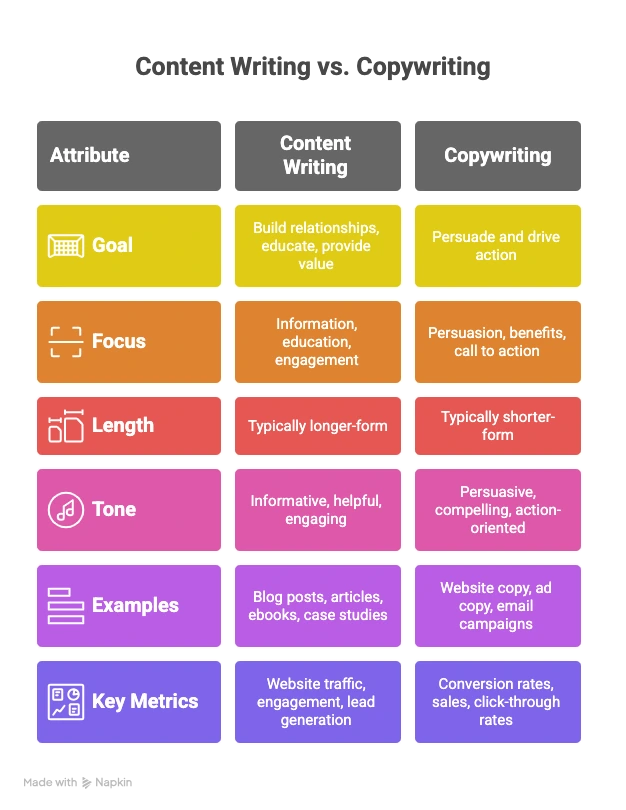
In practice, the lines can blur. A great blog post (content writing) will often end with a persuasive CTA (copywriting). The most important takeaway is that they are complementary skills, both vital for converting a stranger into a loyal customer 4.
The Secret Sauce: Tried-and-True Copywriting Formulas
You might think great copy springs from a place of pure, unstructured creativity. But the truth is, the most effective copy often follows a psychological blueprint a formula that guides the reader on a journey from indifference to action 2.
These formulas aren’t “cheat codes”; they’re time-tested structures that help organize your message for maximum impact. Think of them as recipes. You still need quality ingredients (your ideas and insights), but the recipe ensures you combine them in the most effective order 2. Let’s look at three of the most powerful ones.
1. AIDA: The Classic Four-Step Journey
AIDA is one of the oldest and most foundational marketing formulas, created by E. St. Elmo Lewis over a century ago. It maps the logical path a customer takes toward a purchase 3.
A – Attention: First, you must grab the reader’s attention with a compelling headline, a surprising statement, or a provocative question.
I – Interest: Once you have their attention, you must build interest by presenting information that is relevant, fresh, and appealing to them.
D – Desire: Then, you transform that interest into desire by highlighting the benefits of your product or service and showing how it improves the customer’s life.
A – Action: Finally, you clearly ask for the action you want them to take, such as “Buy Now,” “Sign Up,” or “Learn More” 2 3.
Example in Action: Apple’s iPhone SE page is a masterclass in AIDA. The headline “iPhone SE” is simple and attention-grabbing for those seeking a more affordable iPhone. The sub-headline “Lots to love. Less to spend.” builds interest by addressing a key customer desire. The price point, “Starting at $399,” creates desire by offering premium features at an accessible cost. And the clear buttons, “Learn more >” and “Buy >,” provide the immediate action step 3.
2. PAS: The Problem-Solver
The PAS formula is incredibly reliable because it’s built on a universal truth: people are motivated to solve their problems .
P – Problem: Identify a problem your target audience is facing. Sometimes, you even make them aware of a problem they didn’t know they had.
A – Agitate:Gently intensify the problem. Don’t just state it; explore the negative consequences and frustrations associated with it. This builds empathy and makes the need for a solution feel urgent.
S – Solution: Introduce your product or service as the clear, logical solution to the problem you’ve just agitated 2 3.
Example in Action: A marketing consultant might use PAS like this: “Struggling to get leads from your website? (Problem). You’re putting in all this effort creating content and running ads, but the phone just isn’t ringing. It’s frustrating, and it’s costing you real revenue every single day (Agitation). Let’s change that. Our marketing audit service identifies exactly what’s broken and gives you a clear plan to fix it (Solution)” 3.
3. Before-After-Bridge: The Visual Transformer
This formula is all about creating a vivid contrast that makes the value of your offer undeniable.
Before: Paint a picture of your customer’s current, less-than-ideal situation. Describe the struggle, inconvenience, or frustration they experience.
After: Then, vividly describe the happy, transformed world they could enjoy after their problem is solved. What does their life look like? What positive emotions do they feel?
Bridge: Finally, present your product or service as the “bridge” that takes them directly from the “Before” to the “After” 2 3.
This formula is famously used in before-and-after scenarios, like weight loss or skincare ads, but it can be applied to almost any product. For instance, a meal-prep service might describe the stress of figuring out dinner every night (Before), the peace of mind of having healthy, ready-to-eat meals (After), and their weekly subscription as the simple solution (Bridge).
Why Copywriting is a Career Worth Considering
Beyond being a critical business skill, copywriting can be an incredibly rewarding career path. If you have a way with words and a curious mind, it might just be the perfect fit. Here’s why.
Freedom, Flexibility, and Financial Reward
One of the biggest draws of a copywriting career is the incredible flexibility it offers. Many copywriters work as freelancers, which means they can often choose when they work, where they work, and whom they work for 1. This career can give you the freedom to work from home, a coffee shop, or even while traveling the world—all you truly need is a laptop and an internet connection 6.
Financially, it can be very lucrative. There’s a persistent myth that writers can’t make a good living, but professional copywriters can command excellent rates 1. Your income potential often grows with your experience and your ability to specialize in a high-demand niche. As you build a reputation for delivering results that boost your clients’ bottom lines, you can significantly increase your earnings 6.
It’s a Skill in High Demand
Every business, from a solo entrepreneur to a massive corporation, needs copywriting. It’s the foundation of all marketing and sales communication 6. Before a company can create a brand, run a marketing campaign, or even build a sales team, it needs clear, persuasive messaging—and that’s the copywriter’s job 6. This universal need means there are always opportunities for skilled writers who can understand a business and speak directly to its customers.
It’s a Timeless and Future-Proof Craft
While marketing channels evolve (from print to radio to TV to the internet), the fundamental principles of persuasion and storytelling remain the same. Copywriting is a timeless craft because it’s built on human psychology 6. Furthermore, while AI tools can generate content, they lack the human capacity for genuine empathy, creativity, and strategic insight. The best copy connects on an emotional level, something AI cannot authentically replicate 6 10. This makes skilled human copywriters more valuable than ever.
How to Start honing Your Copywriting Skills
Whether you want to write copy for your own business or for clients, getting started is about combining learning with practice.
- Get the Right Training: The biggest mistake aspiring copywriters make is assuming that being a “good writer” is enough. Copywriting is a specialized skill with its own principles and techniques 5. Invest in learning the fundamentals, such as the difference between features and benefits, how to write compelling CTAs, and how to structure a sales funnel 5.
- Become a Student of Persuasion: Start paying attention to the marketing messages you see every day. Why did that email subject line make you click? What made that website’s sales page convincing? Collect examples of copy you admire—this is known as building a “swipe file”—and analyze what makes it effective 8.
- Practice, Practice, Practice: The best way to learn is by doing. Try rewriting a boring product description from a website. Draft a compelling social media post for a brand you love. Create a sample sales page for an imaginary product. Theory will only get you so far; you learn the most by applying the formulas and techniques yourself 2 3.
Conclusion: The Power of Words
Copywriting is far more than just writing clever slogans. It’s a dynamic and powerful discipline that sits at the intersection of psychology, creativity, and business strategy. It’s the force that builds brands, drives growth, and forges lasting connections with customers.
For the business owner, understanding its principles is no longer optional—it’s essential for standing out in a crowded marketplace. For the aspiring writer, it represents a path to a fulfilling, flexible, and financially rewarding career that is built on a skill that will never go out of style.
So, the next time you find yourself captivated by an ad or effortlessly moving through a website towards a purchase, take a moment to appreciate the craft. Those words were chosen with care, guided by strategy, and designed to make a difference. And with a bit of study and practice, you can learn to wield that power yourself.
10 Web Pages