

The Complete Guide to Solo Ads: Are They Worth It in 2025?
Introduction: What Exactly Are Solo Ads?
Imagine being able to tap into a ready-made audience of thousands of potential customers—people who already trust the recommendation of the person whose emails they eagerly open. That’s the fundamental promise of solo ads, an often-misunderstood yet powerful form of online advertising.
If you’ve ever struggled to get traffic to your website or felt overwhelmed by the complexity of platforms like Facebook Ads, you’re not alone. Many entrepreneurs and marketers are constantly searching for that secret weapon to jumpstart their growth. In this comprehensive guide, we’ll dive deep into the world of solo ads, stripping away the hype and giving you an honest, practical look at how they work, when they’re worth your investment, and how to avoid the common pitfalls that burn many beginners.
So, what exactly is a solo ad? In simple terms, a solo ad is when you pay an owner of an email list to send a dedicated email promoting your offer to their subscribers 1 8. You’re essentially “renting” their audience for a single broadcast. Unlike a traditional newsletter that might have several sections and advertisers, a solo email is solely focused on your product, service, or lead magnet 1. This singular focus is what makes them particularly effective when done correctly.
The appeal is obvious: speed and simplicity. While search engine optimization (SEO) can take months to yield results, solo ads can drive traffic to your landing page within hours 6 8. For someone launching a new product or looking to quickly build an email list, this instant gratification is incredibly attractive. But as with all things that seem too good to be true, there’s a catch—the quality of your results hinges entirely on the quality of the list you’re renting.
Solo Ads vs. The World: How Do They Compare to Other Advertising Methods?
To truly understand where solo ads fit in the digital marketing landscape, it’s helpful to compare them to the two biggest players: Facebook Ads and Google Ads. Each of these channels has unique strengths and weaknesses, and the “best” choice always depends on your specific goals, budget, and timeline.
Solo Ads vs. Facebook Ads: The Speed vs. Scalability Debate
This is perhaps the most common comparison for marketers looking to generate leads quickly. Here’s a breakdown of how they stack up:
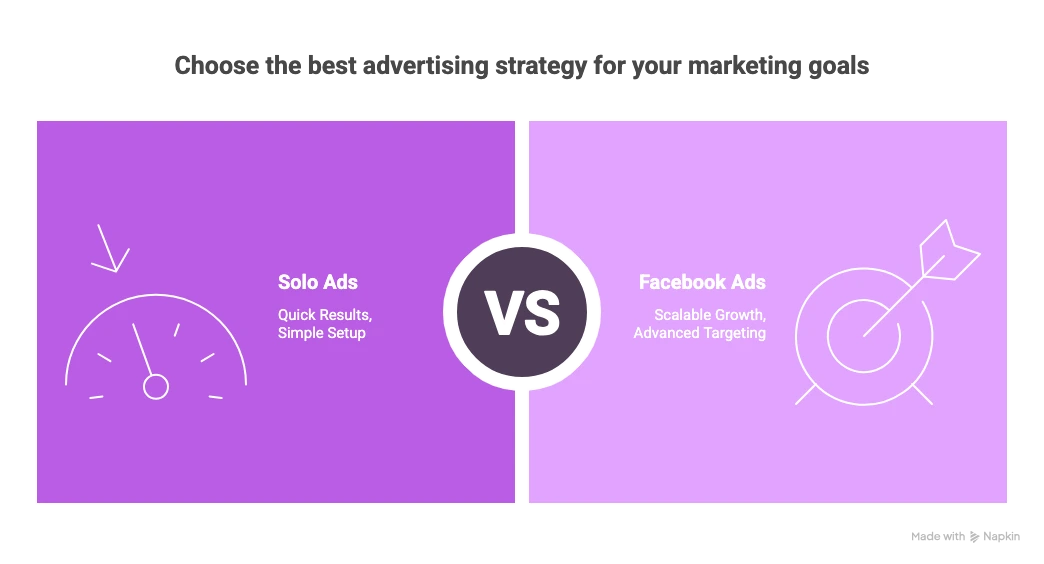
The table highlights the core trade-off. Solo ads are your go-to for simplicity and speed. You can get started with just a landing page and a small budget, making them accessible for beginners. There’s no need to learn a complicated platform or worry about your ad account being shut down unexpectedly.
Facebook Ads, on the other hand, offer unparalleled targeting and the ability to build a brand over time. While they have a steeper learning curve and come with the risk of policy-related ad account suspensions 7, they allow you to build retargeting pools—an asset that continues to give value long after the initial campaign.
Solo Ads vs. Google Ads: Intent vs. Interruption
The comparison with Google Ads revolves around a different concept: user intent.
- Google Ads capture high intent. Someone is actively searching for a solution you provide. They’re in “research” or “buying” mode, which often leads to higher conversion rates for commercial offers. The downside? The cost per click (CPC) in competitive niches can be very high, sometimes ranging from $1.00 to $5.00 or more 6.
- Solo Ads are more akin to interruption marketing. You’re presenting an offer to an audience that isn’t necessarily searching for it at that moment. However, a key advantage is that you’re leveraging the trust and relationship built by the list owner. If the vendor has a highly engaged list, subscribers are more likely to act on the recommendation 2. Furthermore, solo ad clicks are often significantly cheaper than competitive Google Ads keywords 1.
The Strategic Implications: Weighing the Pros and Cons
Understanding the comparisons above naturally leads to a discussion of the inherent advantages and disadvantages of using solo ads as part of your marketing strategy.
The Bright Side: Why Solo Ads Can Be a Game-Changer
- Instant Traffic and Rapid List Building: This is the number one benefit. If you need to grow your email list or generate leads for a launch quickly, few methods are faster. You can go from zero to collecting subscriber emails in less than a day 6.
- Access to a “Warm” Audience: The best solo ad vendors have lists comprised of “buyers”—people who have purchased something based on a recommendation before. This means you’re not dealing with cold traffic; these leads are already in a “buy mode” 2.
- Simplicity and Ease of Use: The process is straightforward. Find a vendor, provide your email copy and link, and pay for the clicks. You bypass the technical complexity of modern ad platforms 8.
- Excellent for Testing: Solo ads provide a cost-effective way to test new markets, offers, or landing pages. Before investing heavily in product creation or a long-term content strategy, you can use a small solo ad buy to gauge interest and conversion potential 6.
The Caveats: Understanding the Risks
- The Quality Dilemma: This is the biggest risk. The success of your campaign lives and dies with the quality of the vendor’s list. Some lists are highly engaged, while others are “burnt out” from too many promotions or, worse, contain bot traffic that will never convert 1 6. As highlighted by one marketing resource, some lists “may be filled with bots that behave like regular email subscribers (they open and click your emails) but don’t end up converting” 1.
- Cost and ROI Uncertainty: Solo ads typically cost between $0.30 and $1.00 per click 2 6. If your sales funnel isn’t optimized—meaning your landing page doesn’t convert visitors into subscribers or customers—it’s easy to burn through your budget without a positive return on investment (ROI).
- No Long-Term Asset: Unlike with content marketing or social media where you build your own audience, you don’t own the email list you’re advertising to. You are essentially renting traffic for a one-time boost 7.
- Limited Control: You have little control over how the email is presented or when it’s sent. You’re placing your brand’s reputation in the hands of the vendor 6.
Making Solo Ads Work for You: A Step-by-Step Guide
If you’ve weighed the pros and cons and decided to test solo ads, following a disciplined process is non-negotiable. Here’s how to stack the odds in your favor.
Step 1: Finding a Reputable Vendor
This is the most critical step. A good vendor is transparent and has a well-maintained list. Start your search on dedicated marketplaces like Udimi, which is widely recommended for its vendor rating system and built-in protections against fake clicks 4 7. Other platforms include TrafficForMe and SoloAdsX 4.
Key questions to ask a potential vendor:
- How was your list built? (Ideal answer: through organic website traffic or paid ads to a squeeze page) 1.
- What is your average open and click-through rate? (Use industry benchmarks to judge the answer) 1.
- What type of offers typically perform well with your list? 1.
- How do you handle hard bounces and spam complaints? (A professional will remove hard bounces quickly and have a spam complaint rate below 0.2%) 1.
Step 2: Crafting a Compelling Email Swipe
The “swipe” is the pre-written email copy you provide to the vendor. Its job is to grab attention and generate clicks. Some vendors offer to write this for you, which can be beneficial as they know what resonates with their audience 6.
Elements of a high-converting solo ad email:
- An intriguing subject line: This is your first and most important impression. Make it benefit-driven without being clickbaity.
- A personal, conversational tone: The email should sound like it’s coming from the list owner. The vendor’s subscribers know and trust them, so the message should maintain that voice.
- A clear problem-agitate-solution structure: Briefly introduce a common problem, agitate the pain point, and then present your offer as the solution.
- A strong call-to-action (CTA): Tell the reader exactly what you want them to do next (e.g., “Click here to learn the secret,” “Get your free guide now”).
Step 3: Optimizing Your Landing Page
Your solo ad is useless if your landing page doesn’t convert. The page must deliver on the promise made in the email. It should have a clear headline, minimal distractions, and a simple opt-in form or buy button 6. The messaging between the ad and the landing page must be congruent; any disconnect will cause visitors to leave.
Step 4: The Golden Rule – Start Small and Track Everything
Never, ever make a large purchase from a new vendor. Your first order should always be a small test buy of 100-200 clicks 1 6. This minimizes your risk while allowing you to gather data.
Use a link-tracking tool (many marketplaces like Udimi have them built-in) to monitor clicks, and most importantly, track your opt-in rate (the percentage of clicks that become subscribers) and any sales. If the test shows promise—a good opt-in rate and a positive ROI—you can then scale up with confidence.
Conclusion: Are Solo Ads Right for You?
Solo ads are not a mythical “magic bullet” for instant online success. They are a specific tool with specific uses. They have matured from their earlier, shakier reputation and, when used strategically, can be a powerful component of a diversified marketing plan 2.
So, should you use them? Solo ads are an excellent fit if:
- You are a beginner looking for a simple way to get started with paid traffic.
- You need to build an email list or generate leads quickly for a product launch.
- You have a budget to test (a few hundred dollars) and a well-optimized funnel.
- You operate in a niche like “make money online,” affiliate marketing, or other areas where solo ads are prevalent 2 8.
You might want to look elsewhere if:
- You are promoting local businesses, e-commerce products, or SaaS platforms, as these may not align well with typical solo ad lists 2.
- You are looking to build a long-term, scalable brand asset without recurring costs.
- You don’t have the patience or budget to test multiple vendors to find a good one.
The key takeaway is that success with solo ads requires due diligence, careful testing, and realistic expectations. Don’t fall for big promises. Start small, track your metrics meticulously, and always prioritize building a relationship with reliable vendors. When you find a source of quality traffic that converts, it can indeed become one of the fastest ways to grow your business.
Have you ever tried solo ads? Share your experiences or questions in the comments below